
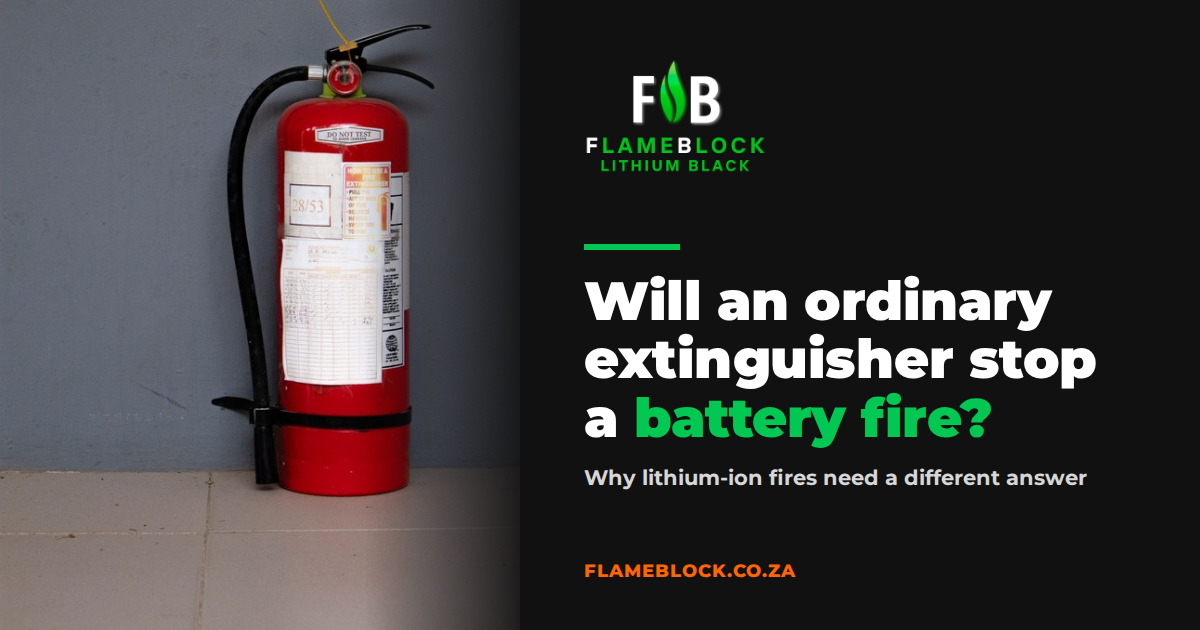
An ordinary extinguisher may not be enough because a lithium-ion battery in thermal runaway makes its own heat inside the casing. Powder and CO2 can knock the flames down, and the fire can return once the agent runs out. FlameBlock Lithium Black is built for that gap. In any battery fire, get people out first.
Key insights
- They burn very hot: TT Club, a global transport and logistics insurer, says lithium-ion fires “can burn at temperatures exceeding 1,000°C”, with toxic gas and “potential re-ignition” (Insurance Edge, 25 September 2026).
- Solar systems are linked to a lot of fires: Fire Ops SA, a private fire and rescue service, says “a quarter of all structural fires we respond to are linked to solar systems” (Fire Ops SA and Discovery Insure release, 8 September 2026). That’s its own call-out data, not a national figure.
- A battery fire can run for a day: at a container battery fire in Constantia Kloof, Roodepoort, in January 2026, crews stayed about 24 hours (Green Building Africa, 9 September 2026).
- Don’t fight it alone: Fire Ops SA and Discovery Insure say homeowners “shouldn’t attempt to manage a lithium-ion battery fire themselves”.
- Lithium Black is made for this job: a South African mineral-and-salt agent for lithium-ion battery fires, in extinguisher sizes and an in-box option.
What makes a lithium-ion battery fire different?
It feeds itself. A damaged, overcharged or overheated cell starts a chemical reaction that releases heat, and that heat pushes the next cell over the edge. Then the next. This chain is called thermal runaway.
The fire burns past 1,000°C according to TT Club and gives off toxic, flammable gas. A battery that looks finished can heat up and flare again.
Think of the backup battery behind your inverter, the e-bike in the passage, or the UPS (uninterruptible power supply) keeping the office server alive.
Can a normal fire extinguisher put out a lithium battery fire?
Not always. The flames are only the visible part of the fire. Dry chemical powder (DCP) and carbon dioxide (CO2) extinguishers, the kind common in homes and offices, work by smothering the flames or breaking the combustion. They do that well. What they don’t do is take enough heat out of a cell that is still cooking from the inside.
So the flames drop, the powder settles, and the cell is still hot. When the agent runs out, the fire can start again. FlameBlock says conventional extinguishers “often prove to be ineffective” on lithium-ion battery fires (FlameBlock Lithium Black product page). That is the company’s claim, not independent testing.
Take the Roodepoort fire. Fire Ops SA arrived in under seven minutes with nine vehicles. Green Building Africa reports the crews kept cooling the battery container for hours, tracking hot spots with a drone’s thermal camera, until it settled at about 30°C. Chief Fire Officer Wynand Engelbrecht said “cooling, monitoring and environmental control are critical.”
A hand-held extinguisher holds a few kilograms or litres of agent. Set that against hours of cooling.
How common are battery fires in South African homes?
Common enough that one fire service now puts a number on it. According to the Fire Ops SA and Discovery Insure release, about one in four structural fires (fires in buildings) that Fire Ops SA attends are linked to solar systems. The same release quotes Statistics South Africa’s 2025 General Household Survey: around 675,000 homes now have solar, up 86% in three years.
The causes it lists are ageing or faulty batteries, inverter faults, loose wiring, worn connections and poor installation. Discovery Insure’s Saqib Hossain says: “A solar system isn’t something that you install and forget about. Many of these were installed at the height of loadshedding.”
Fire Ops SA CEO De Wet Engelbrecht says the first 15 to 20 minutes “can determine whether a fire is contained or spreads into other parts of the home, including the roof”.
What should you do if a battery starts smoking?
Get everyone out and call the fire service. Close the door behind you if you can. In South Africa, 112 works from any cellphone. Call your installer after that.
Warning signs include swelling, a strange smell, hissing, a casing that’s hot to the touch and fault codes on the inverter. Any of those is a reason to stop using it and get help.
Where does an extinguisher fit, then? On a small fire, in the first moments, with someone who knows how to use it and a clear exit behind them. It’s no reason to stay in a smoky garage. If you do reach for one, you want an agent made for this kind of fire.
Where does FlameBlock Lithium Black fit?
Lithium Black is an extinguishing agent made from a mixture of minerals and salts, built specifically for lithium-ion battery fires. Ferdi van Zyl and chemist Dr Deon de Wet-Roos developed it over two years in South Africa (Engineering News, 7 June 2024).
FlameBlock states that it brings a burning battery from around 1,100°C down to about 80°C, interferes with the battery’s chemical reaction, forms a layer that helps contain dangerous gases such as hydrogen fluoride, and is designed to stop the battery reigniting.
There are two ways to use it:
- In an extinguisher, in 2L, 6L and 9L sizes. The 2L is the compact one, for power tools and electronics within reach.
- Inside the battery housing. The agent sits in the box and, as Engineering News described it, is “temperature-graded to release contents only when sustained heat exposure occurs”. It’s there at 2am on a Sunday when nobody is.
Five things to check this week
- Where the battery lives. Fire Ops SA’s advice, reported by TimesLive, 8 September 2026: “Don’t install it inside your house, don’t install it inside the main passage, don’t even install it in your garage.” For the room itself, see sealing the gaps around battery rooms.
- A smoke detector near the equipment, so you hear about a problem early (TimesLive).
- Your insurer knows about the system. Discovery Insure says to disclose it.
- A yearly check by your installer, like a car service.
- What’s mounted next to the battery. If it’s a standard powder extinguisher, think about adding one made for lithium-ion fires.
Frequently asked questions
Can I use water on a lithium-ion battery fire?
Not on your own. Firefighters cool battery fires for hours, as they did at Roodepoort, with the crews and water supply to match. A garden hose in a garage is a different thing. Get out and call the fire service.
Will a dry powder extinguisher put out a burning power bank?
It may knock the flames down. It may not stop the cell heating up again, which is why the fire can return.
Is Lithium Black only for big battery rooms?
No. It comes in 2L, 6L and 9L, and the in-box option goes inside the battery housing itself.
What should I do if my solar battery starts smoking?
Get everyone out and call the fire service on 112, which works from any cellphone in South Africa. Then call your installer.
Where should I install a home battery?
Fire Ops SA’s advice, reported by TimesLive, is not to put it inside your house, in the main passage or even in your garage. Add a smoke detector near the equipment and tell your insurer about the system.
What type of fire extinguisher works on a lithium battery fire?
One made for lithium-ion battery fires. Powder and CO2 may knock the flames down without taking enough heat out of the cell. FlameBlock Lithium Black is a South African agent made for this job, in extinguishers and as an in-box option inside the battery housing.
The bottom line
A battery on the wall is normal in South Africa now. A fire plan built for it isn’t, yet. Get the placement and the yearly check right. Then make sure the extinguisher nearest the battery was designed for the fire it would face. FlameBlock can help you choose a size and tell you whether the in-box option suits your equipment.
Editorial note: this article is general guidance, not a fire risk assessment. Product performance figures are FlameBlock’s own. Confirm what your site needs with a fire professional.
PROTECT YOUR BATTERIES
Tell FlameBlock what your battery system looks like and they will say which Lithium Black option suits it.
sales@flameblock.co.za | +27 11 590 3337 | flameblock.co.za


